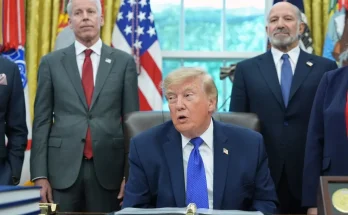
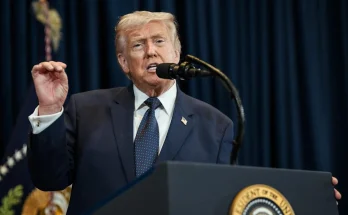
Donald Trump smiles accompanied by Melania Trump, in Palm Beach County Convention Center, in West Palm Beach, Florida. Photo by Carlos Barria/ Reuters
For months, Trump has touted a plan to give Americans a “tariff dividend” refund. With the start of the new year, Americans wonder if they should expect a $2,000 check.
In early November, the president again floated the idea of issuing $2,000 payouts to “middle-income people and lower-income people” from the collected tariff revenues.
“Next year is projected to be the largest tax refund season ever, and we’re going to be giving back refunds out of the tariffs, as we have taken in literally trillions of dollars,” Trump said during a Dec. 2 cabinet meeting. “We’re going to be giving a nice dividend to the people in addition to reducing debt.”
But experts have said that tariff revenue likely won’t cover the cost of issuing such checks.
In September, the Treasury Department said it had generated $195 billion in tariff-related revenue. The Bipartisan Policy Center calculated $194.9 billion in net tariff revenue in 2025, which would come up short of the estimated $300 billion cost of sending the checks.
Tax Foundation estimates that Trump’s tariffs will raise $2.1 trillion in revenue over the next decade, but that dips to $1.6 trillion after accounting for foreign retaliation and other negative economic effects. The Congressional Budget Office has projected tariff revenue of $3.3 trillion over a decade.
Are $2,000 ‘tariff dividend’ checks on the horizon?
Tariff dividend checks would likely require legislation passed by Congress, as was the case with the federal economic impact payments that went out in 2020 and 2021. These were the last such federal stimulus payments agreed upon and issued by the government to the general public.
A bill called the American Worker Rebate Act of 2025 was introduced by Sen. Josh Hawley, R-Missouri, in July, proposing the use of tariff revenue to issue checks between $600 and $2,400 to American taxpayer families. It was referred to the Committee on Finance, where it received no further action.
White House economic adviser Kevin Hassett likewise told CBS News’ “Face the Nation with Margaret Brennan” on Dec. 21 that the president would “bring forth a proposal to Congress” about dividend checks in 2026.
Hassett said that the funding for the checks could come from sources beyond tariffs.
“We get taxes, we get tariffs, we get revenue from lots of places, and then Congress decides how to spend those monies,” he told Brennan. “That’s an appropriation. And so this would have to be money that would be an appropriation.”
But plans for any related money allocation could be thwarted altogether if Trump’s tariffs are struck down by the Supreme Court, which seemed to question whether Trump has the power to impose such tariffs when listening to arguments on Nov. 5.
As of January 2026, no solid plans have been enacted to bring the checks to fruition.
Are other stimulus checks coming?
In February, Trump also said he would consider a plan to issue $5,000 stimulus checks to taxpayers in the form of a “DOGE dividend” during a summit in Miami.
He explained that it would partly take the savings claimed by Elon Musk’s Department of Government Efficiency (DOGE) and give it to taxpayers. However, the amount of money actually saved by the department has been called into question and Musk has since left the administration, rendering DOGE somewhat defunct.
The administration has shared no further information or plans for the DOGE checks.
On Dec. 18, the president announced he was sending $1,776 checks, called “Warrior dividends,” to the nation’s 1.45 million service members before Christmas. The Defense Department supplied the funding, the Pentagon said.
How to avoid stimulus check scams
As plans for any forthcoming checks remain unclear, stimulus scams have become so widespread that the IRS has cautioned the public to stay vigilant.
The IRS issued a warning in July about fake messages regarding “tax credits” or “stimulus” checks from scammers pretending to be the agency.
“These messages will often direct taxpayers to click fraudulent links they claim are IRS websites or other online tools,” the agency said. “The IRS only sends text messages with the taxpayer’s permission and only collects the taxpayer’s cell phone number or email address if they subscribe to receive messages from the agency.”
The IRS also doesn’t leave pre-recorded, urgent or threatening messages, it said. If you do receive a suspicious call, message, or mail, the IRS suggests:
- Log in to their secure IRS Online Account to see if the letter or notice is in their file
- Review common IRS letters and notices: Understanding Your IRS Notice or Letter
- Contact IRS customer service directly to authenticate it
- Verify that any collection notice from a private collection agency has the same Taxpayer Authentication Number as the Notice CP40 the taxpayer received from the IRS.
Contributing: Maria Francis, USA TODAY NETWORK