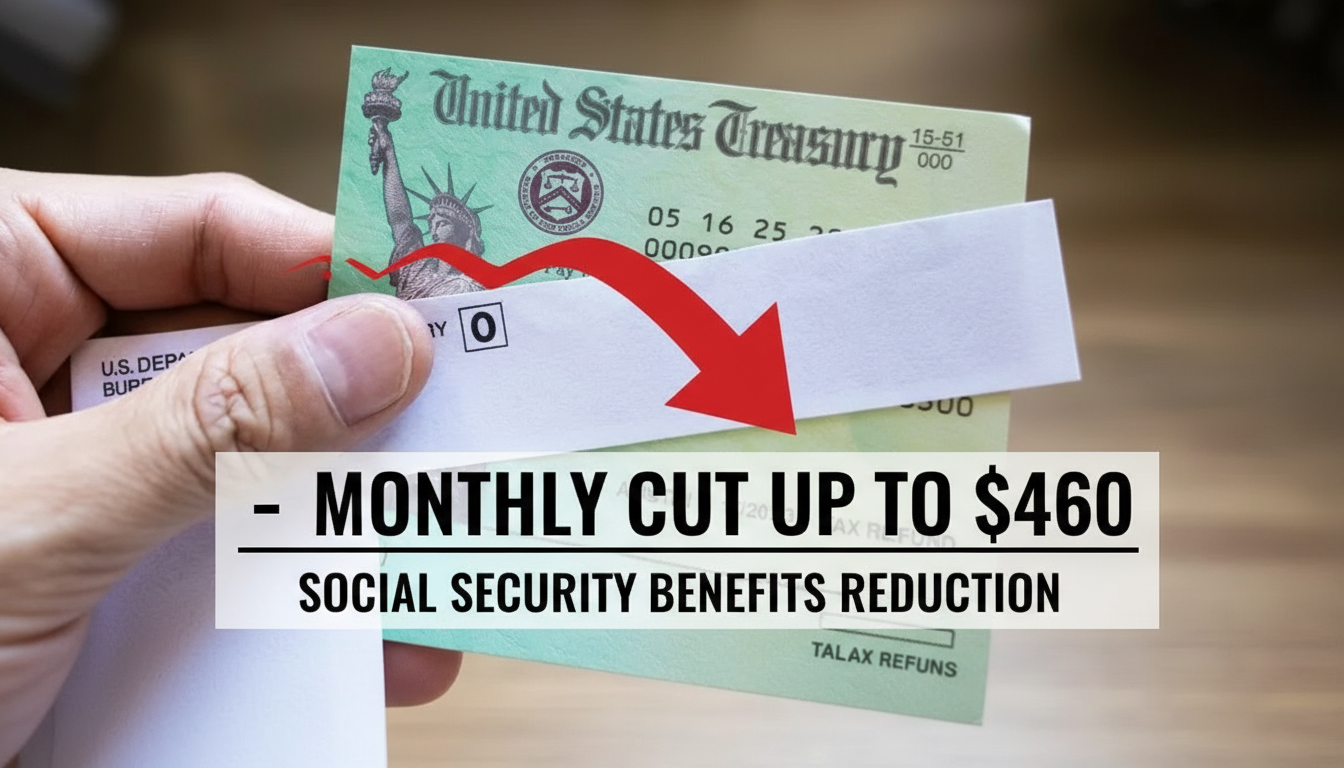
Millions of Americans who rely on Social Security as their primary source of retirement income could face a significant reduction in their monthly benefits in the years ahead — a potential cut that could reach $460 per month for some retirees.
The warning does not stem from a new law or an announced policy change. Instead, it comes from long-standing financial projections tied to Social Security’s funding structure and the future of its trust funds. Unless Congress takes action, current law would require automatic benefit reductions once key reserves are depleted.
Here is what retirees — and those nearing retirement — need to know.
Why Social Security Benefits Could Be Reduced
Social Security is funded primarily through payroll taxes paid by workers and employers. For decades, the system collected more than it paid out, allowing surplus funds to build up in dedicated trust funds.
That balance has shifted.
As more Americans retire and live longer, benefit payments have risen faster than the payroll taxes coming in. To cover the gap, Social Security has been drawing down its Old-Age and Survivors Insurance (OASI) Trust Fund, which supports retirement and survivor benefits.
According to long-term projections, those reserves are expected to be exhausted in the early 2030s if no legislative changes are made.
Under current federal law, Social Security cannot borrow money to pay benefits. Once the trust fund runs out, benefits must be limited to the amount of revenue collected each year from payroll taxes.
That reality is what could trigger an across-the-board reduction.
How Big Could the Cut Be?
If the trust fund is depleted, Social Security would be able to pay only about 75% to 80% of scheduled benefits, based on ongoing tax revenue.
For retirees, that would translate into a reduction of roughly 23% to 25%.
-
A retiree receiving $2,000 per month could see their benefit drop by about $460
-
Someone receiving $1,600 per month could lose roughly $360
-
Higher earners with larger checks would see larger dollar cuts
The exact amount would vary depending on each person’s current benefit level, but the percentage reduction would apply broadly.
What This Does Not Mean
Despite alarming headlines, several important points often get lost:
-
Social Security is not going bankrupt. Even if the trust fund runs out, the program would still collect payroll taxes and continue paying benefits.
-
There is no immediate cut happening in 2026. These projections apply to the next decade, not the current year.
-
Benefits would not disappear entirely. Payments would be reduced, not eliminated.
In short, retirees would still receive checks — just smaller ones — unless Congress intervenes.
Why Lawmakers Haven’t Fixed It Yet
Both Democrats and Republicans acknowledge Social Security’s long-term funding challenge, but agreement on solutions has been elusive.
Some proposals focus on increasing revenue, such as:
-
Raising payroll tax rates
-
Increasing or eliminating the cap on wages subject to Social Security taxes
Others emphasize reducing future costs, including:
-
Gradually raising the full retirement age
-
Adjusting benefit formulas for higher earners
More controversial options include transferring money from the general federal budget or restructuring benefits entirely.
Historically, Congress has stepped in before trust fund depletion occurred — most notably in the 1980s — but analysts warn that delaying action makes the eventual fix more painful.
Why This Matters So Much to Retirees
For many older Americans, Social Security is not supplemental income — it is the foundation of their monthly budget.
Studies consistently show:
-
About half of retirees rely on Social Security for at least 50% of their income
-
Roughly one in four depend on it for nearly all their income
A reduction of several hundred dollars a month could force difficult decisions involving housing, healthcare, food, and utilities — especially as inflation and medical costs remain high.
What Retirees and Future Retirees Can Do Now
While individuals cannot control congressional action, financial experts suggest several steps to reduce risk:
-
Delay claiming benefits, if possible, to increase monthly payments
-
Build supplemental savings through retirement accounts
-
Review household budgets with a conservative outlook
-
Stay informed through official Social Security updates, not social media rumors
Importantly, any actual change to benefits would require clear public notice and would not happen overnight.
The Bottom Line
The possibility of a $460 monthly cut to Social Security benefits reflects a future funding shortfall, not an announced policy decision. If lawmakers do nothing and trust fund reserves are depleted, current law would require benefits to be reduced to match incoming revenue.
Whether those cuts ever take effect depends entirely on Congress.
For now, retirees continue to receive full benefits — but the debate over Social Security’s future is becoming more urgent as the projected deadline approaches.