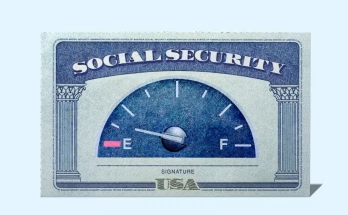
As millions of Americans depend on Social Security for retirement income, confusion continues growing over who actually qualifies for monthly benefits in 2026.
Recent reforms signed into law restored payments for millions of retirees affected by older federal rules. But despite those changes, current Social Security law still excludes certain Americans from receiving benefits altogether.
The reason comes down to one central rule that has governed the system for decades:
Social Security benefits are primarily available to workers who paid enough Social Security taxes during their careers.
As of May 27, 2026, two major groups remain largely ineligible under federal law.
Full Breakdown of Who Cannot Receive Social Security Benefits in 2026
| Group | Main Reason for Ineligibility | Common Examples |
|---|---|---|
| Workers without enough Social Security credits | Did not contribute enough payroll taxes during working years | Cash workers, some self-employed individuals, late-arriving immigrants |
| Workers employed in non-covered government pension systems | Jobs were exempt from Social Security taxes | Certain teachers, police officers, firefighters, and older federal workers |
Group 1: Workers Who Never Earned Enough Social Security Credits
The largest category of ineligible Americans includes individuals who never accumulated the minimum number of work credits required by the Social Security Administration.
Under current federal law, most workers must earn at least 40 work credits to qualify for retirement benefits.
In practical terms, that usually equals approximately 10 years of employment in jobs where Social Security payroll taxes were deducted from earnings.
Workers earn credits through:
- Wages reported by employers
- Self-employment income reported to the IRS
- Payroll taxes paid under the Federal Insurance Contributions Act (FICA)
Without enough credits on record, a person generally cannot receive retirement benefits later in life.
Why the Credit System Exists
Social Security operates as a contribution-based insurance system.
Throughout a worker’s career:
- Employees contribute payroll taxes
- Employers match those contributions
- Self-employed individuals pay self-employment taxes
Those contributions help fund benefits for current retirees while also building future eligibility for the worker.
The basic rule remains straightforward in 2026:
No meaningful contribution history usually means no retirement benefit.
Most Common Workers Affected
Cash or “Off-the-Books” Workers
Some individuals work for years in jobs where wages are paid entirely in cash without official tax reporting.
Because no Social Security taxes are submitted, those years often do not count toward eligibility.
Certain Self-Employed Individuals
Self-employed workers must report income and pay Social Security taxes independently.
Workers who underreport earnings or fail to pay required taxes may later discover they earned few or no qualifying credits.
Older Immigrants
Immigrants who move to the United States later in life may not have enough time to build the required 40-credit work history before reaching retirement age.
Workers with Long Career Gaps
Extended periods outside the labor force can also prevent workers from reaching minimum eligibility thresholds.
2026 Social Security Credit Requirements
| Requirement | Current Rule in 2026 |
|---|---|
| Minimum credits needed for retirement benefits | 40 credits |
| Approximate work history required | About 10 years |
| Credits earned through | Taxed wages or self-employment income |
| System administrator | Social Security Administration |
Group 2: Workers in Jobs Not Covered by Social Security
The second major category includes public workers employed in pension systems that historically operated outside Social Security.
For decades, certain state, local, and federal government jobs did not participate in the Social Security system.
Instead, workers contributed to separate public pension plans.
This category often included:
- Teachers
- Police officers
- Firefighters
- Municipal workers
- Some state employees
- Older federal employees under the Civil Service Retirement System (CSRS)
Because these workers did not pay Social Security taxes from those paychecks, some remain ineligible for benefits tied to those earnings.
The Social Security Fairness Act Changed the System in 2025
Congress passed the Social Security Fairness Act in early 2025, eliminating two highly controversial rules that had reduced benefits for many retirees.
Repealed Federal Rules
| Former Rule | What It Previously Did |
|---|---|
| Windfall Elimination Provision (WEP) | Reduced Social Security benefits for some public retirees |
| Government Pension Offset (GPO) | Reduced or eliminated spousal and survivor benefits |
The repeal restored or increased benefits for millions of Americans who had worked both in Social Security-covered employment and in public pension systems.
Many retirees also received retroactive payments covering benefits back to January 2024.
Why Some Government Workers Still Receive No Benefits
One major misunderstanding in 2026 is the belief that all teachers, police officers, and public employees automatically became eligible for Social Security after the law changed.
That is not entirely accurate.
The repeal of WEP and GPO only helps workers who earned qualifying Social Security credits somewhere during their careers.
Workers who spent an entire career in non-covered employment and never paid Social Security taxes may still receive no retirement benefit from the program.
Real-World Examples in 2026
| Worker Situation | Eligible for Benefits? | Reason |
|---|---|---|
| Teacher with 12 years in private-sector employment | Yes | Earned sufficient Social Security credits |
| Firefighter who worked only in non-covered pension systems | Possibly No | Never paid into Social Security |
| Immigrant with 6 years of U.S. employment | No | Did not meet 40-credit requirement |
| Self-employed worker who properly filed taxes for decades | Yes | Paid required Social Security taxes |
| Cash-paid worker with unreported wages | Usually No | Contributions were never recorded |
Other Reasons Benefits May Be Suspended
Even eligible beneficiaries can temporarily lose payments under certain circumstances.
Possible reasons include:
- Long-term incarceration
- Certain immigration-related restrictions
- Living in restricted foreign countries
- Failure to report earnings correctly
- Administrative disputes involving earnings records
These situations are different from permanent ineligibility based on work history requirements.
Growing Financial Pressure on Social Security
The debate over eligibility comes as Social Security faces mounting financial challenges tied to:
- An aging U.S. population
- Longer life expectancy
- Rising retirement costs
- Increasing benefit payouts
Federal projections continue warning that trust fund reserves could face significant shortfalls within the next decade unless lawmakers adopt further reforms.
That has fueled national debates over:
- Raising the retirement age
- Increasing payroll taxes
- Expanding benefits
- Adjusting eligibility rules
For now, however, the system continues operating under contribution-based eligibility standards.
Bottom Line
As of May 27, 2026, two major groups still cannot receive Social Security retirement benefits under current federal law:
- Workers who never earned enough Social Security work credits
- Workers whose careers were spent in jobs outside the Social Security tax system
While the Social Security Fairness Act restored benefits for millions of retirees, it did not eliminate the program’s core requirement:
Americans generally must contribute to Social Security during their working years in order to receive retirement benefits later in life.