The email arrived at 5:17 a.m.
I remember the exact time because it woke me up.
My phone buzzed on the nightstand beside my bed, and I reached for it without opening my eyes.
At first, I thought it was one of the usual notifications.
Instead, I found an email with a subject line that made my stomach drop.
Important Update Regarding Program Funding
I sat up immediately.
My husband, Trevor, was still asleep beside me.
Outside, the streets of Washington, D.C., were quiet.
Inside our apartment, everything still felt normal.
For another sixty seconds.
Then I opened the message.
By the time I finished reading, nothing felt normal anymore.
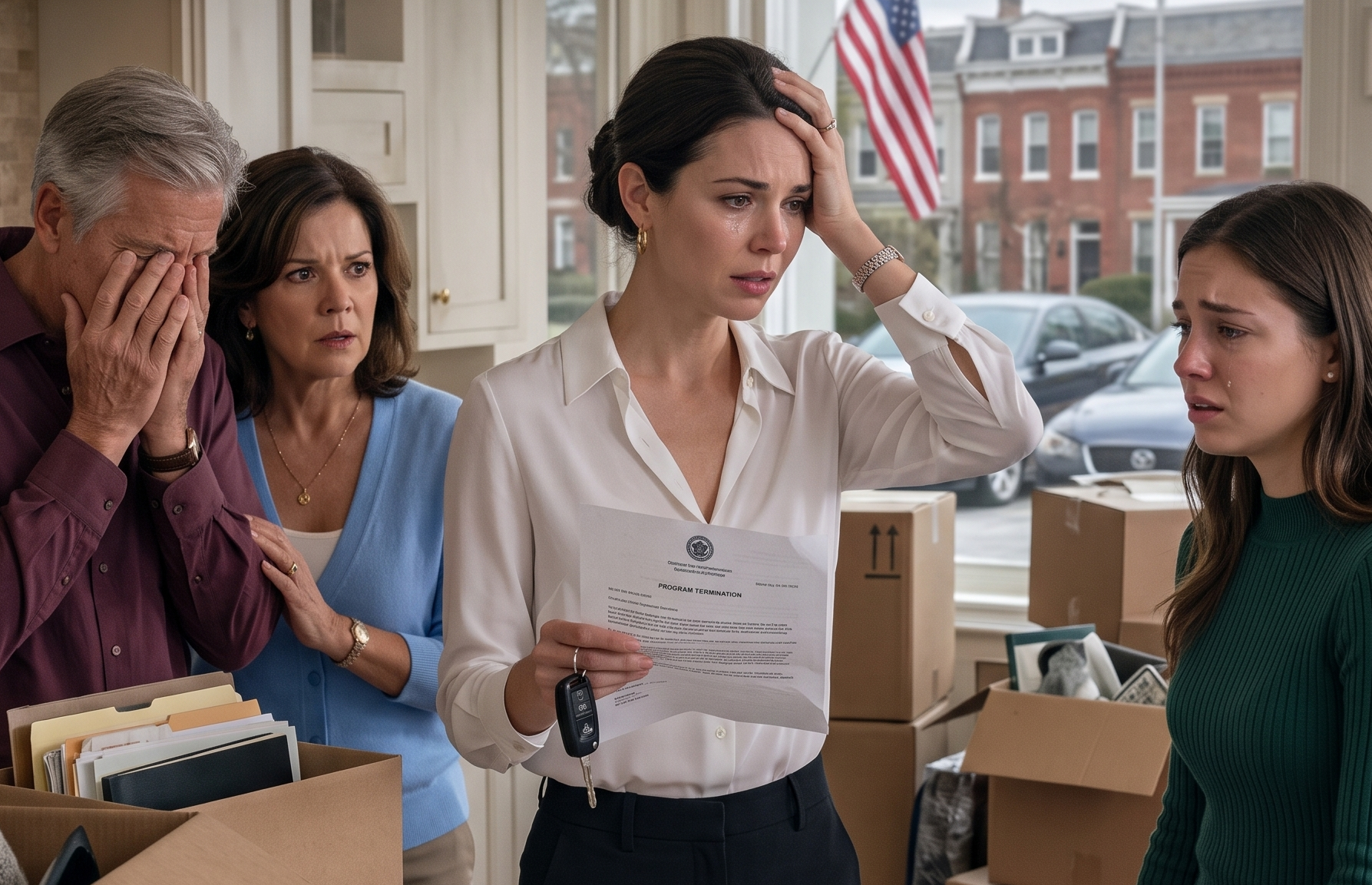
The federal relocation program that had brought hundreds of families—including ours—to Washington was being suspended.
Effective immediately.
Funding frozen.
Housing assistance paused.
Support services under review.
No timeline.
No guarantees.
No answers.
I read it twice.
Then a third time.
Each reading somehow felt worse.
“Trevor.”
He groaned.
“Trevor, wake up.”
My voice must have sounded strange because his eyes opened immediately.
“What happened?”
I handed him the phone.
He read silently.
Then sat up.
Neither of us spoke.
The apartment suddenly felt smaller.
Six months earlier, we had packed our lives into a moving truck and left Ohio behind.
The program had seemed like a miracle.
Affordable housing assistance.
Job placement support.
Educational opportunities for our children.
A fresh start.
We had trusted the promises.
So had hundreds of other families.
Now those promises were disappearing.
And nobody knew what would happen next.
By 8 a.m., the community group chat was exploding.
Questions.
Rumors.
Panic.
People were posting screenshots of emails.
Some had received different wording.
Others had received nothing at all.
Nobody knew which information was accurate.
One father claimed the suspension would last a few weeks.
A mother in another building said she had heard it could be permanent.
A retired veteran posted that he was already looking for another place to live.
Everyone was guessing.
No one actually knew.
At 10 a.m., the community center announced an emergency meeting.
The room was packed.
Families filled every chair.
Parents held babies.
Teenagers sat on the floor.
People who had never spoken before suddenly looked like neighbors facing the same storm.
A government representative stepped to the microphone.
The room fell silent.
Then she said the one sentence nobody wanted to hear.
“We understand your concerns, but at this time we do not have additional information.”
The crowd erupted.
Questions flew from every direction.
“What happens to our leases?”
“What about childcare assistance?”
“What about transportation support?”
“What about people who already left jobs in other states?”
The representative repeated the same answer.
She didn’t know.
Or wasn’t allowed to say.
Either way, it changed nothing.
By the end of the meeting, fear had spread through the room like smoke.
Families left carrying more uncertainty than they had brought with them.
That evening, Trevor and I sat at the kitchen table after the children went to bed.
A notebook lay between us.
Bills.
Rent.
Savings.
Groceries.
School expenses.
Numbers.
Just numbers.
Yet somehow those numbers felt heavier than furniture.
Finally, Trevor spoke.
“How long can we manage?”
I looked down at the page.
The answer was not comforting.
“Maybe four months.”
He nodded slowly.
Neither of us said what we were both thinking.
Four months passes quickly.
Especially when you’re trying to rebuild a life.
I closed the notebook.
That was when someone knocked on our door.
Three sharp knocks.
Unexpected.
When I opened it, I found our elderly neighbor, Mrs. Carlisle.
She lived across the hall and rarely visited anyone.
Tonight she looked worried.
Very worried.
She held a folded newspaper in one hand.
“You need to read this,” she said.
I took it.
The article wasn’t about funding.
It wasn’t about housing.
It wasn’t about our community.
It was about something else entirely.
A government report scheduled to be released the following week.
A report that could affect thousands of families.
Maybe millions.
And according to Mrs. Carlisle, the suspension we were experiencing was only the beginning.
I looked up.
“What is this?”
She glanced nervously down the hallway.
Then lowered her voice.
“The reason they aren’t telling you the truth.”
And suddenly, our funding problem felt much bigger than money.
To be continued… 👇
PART 2
I looked down at the newspaper.
A section had been circled in red ink.
Not the headline.
Not even the main article.
Just a small paragraph buried near the bottom of the page.
Mrs. Carlisle closed the door behind her.
“What exactly am I looking at?”
She sat carefully at our kitchen table.
For a moment, she seemed unsure whether she should continue.
Then she sighed.
“My son works in public policy.”
I waited.
“He called me yesterday.”
Her voice lowered.
“He said several federal support programs are being reviewed at the same time.”
My stomach tightened.
“What kind of review?”
“The kind that decides who keeps funding and who doesn’t.”
Trevor exchanged a glance with me.
Neither of us liked where this conversation was heading.
The article itself was vague.
Budget discussions.
Program evaluations.
Administrative restructuring.
Words that sounded harmless until they affected your family directly.
Mrs. Carlisle tapped the newspaper.
“Most people won’t notice this article.”
I nodded.
She was right.
It looked like ordinary political news.
The sort of thing people skipped while reading.
“But families like ours notice.”
The room became quiet.
Because she was right about that too.
When your future depends on a program, every sentence matters.
Every budget proposal matters.
Every vote matters.
Every decision made by strangers hundreds of miles away suddenly becomes personal.
The next morning, our community looked different.
The playground was quieter.
Parents gathered in small groups.
People spoke in whispers.
Everyone was waiting.
Waiting for answers.
Waiting for news.
Waiting for someone to tell us whether we still had a future in Washington.
Three days later, another email arrived.
This time it was shorter.
Much shorter.
There would be a town hall meeting.
Attendance strongly encouraged.
No additional details.
Just a date.
A time.
And a location.
The message spread through the community instantly.
By the evening of the meeting, the auditorium was overflowing.
People stood along the walls.
Some brought notebooks.
Others brought folders filled with documents.
A few brought lawyers.
The atmosphere felt tense.
Not angry.
Not yet.
Just nervous.
The officials arrived twenty minutes late.
Nobody seemed pleased.
Finally, one woman stepped to the microphone.
She looked exhausted.
As though she hadn’t slept much either.
“Thank you for coming.”
No one applauded.
She continued.
“The purpose of tonight’s meeting is to discuss transition planning.”
My heart sank.
Transition.
That word sounded dangerous.
Then she explained.
The funding suspension would continue.
Certain benefits would end within ninety days.
Some housing assistance programs would be phased out.
Several support offices would close.
The room erupted.
Questions.
Frustration.
Fear.
People spoke over one another.
One mother stood up.
“What happens to families who moved here because of the program?”
The official hesitated.
Then answered honestly.
“We understand this creates hardship.”
Hardship.
An interesting word.
A word that sounds smaller than reality.
Hardship doesn’t fully describe uprooting your children.
Leaving jobs.
Moving across the country.
Trusting promises.
Then discovering those promises have expiration dates.
The meeting continued for nearly three hours.
By the end, everyone understood the same thing.
No rescue was coming.
Whatever happened next would depend on us.
That realization changed the community.
Not immediately.
But steadily.
Something unexpected began happening.
Neighbors started helping neighbors.
A teacher offered free tutoring sessions.
A mechanic organized discounted car repairs.
A retired accountant helped families review budgets.
Someone created a job-sharing network.
Another person started posting daily employment opportunities.
The panic didn’t disappear.
But it transformed.
Into action.
Into cooperation.
Into determination.
One evening, about six weeks later, I walked through the community center.
The same building where everyone had first gathered in fear.
Now it looked different.
Children were doing homework together.
Parents were exchanging resources.
Volunteers were helping people prepare resumes.
People still worried.
But they were no longer waiting.
They were building.
That was when I saw Mrs. Carlisle sitting alone near a window.
She smiled when she noticed me.
“Things look different.”
“They do.”
She nodded.
Then looked around the room.
“Funny, isn’t it?”
“What is?”
“The program brought everyone here.”
I followed her gaze.
Families.
Friendships.
Support.
Community.
“But the funding ending is what made people become neighbors.”
For a moment, neither of us spoke.
Then my phone buzzed.
A new email.
I almost ignored it.
Until I saw the sender.
A company I had interviewed with weeks earlier.
My heart started racing.
I opened the message.
Read the first line.
Then the second.
Then the third.
Trevor appeared beside me.
“What is it?”
I looked up.
Smiled.
And for the first time in months, the future didn’t seem frightening.
It seemed possible.
Very possible.
To be continued…
Part 3
I looked up from the email.
For a second, I couldn’t speak.
Trevor immediately knew.
After months of uncertainty, he had learned to read my face better than words.
“What is it?” he asked again.
I handed him the phone.
His eyes moved across the screen.
Then widened.
“Are you serious?”
I laughed.
A real laugh.
The first one in months.
The company had offered me the position.
Not a temporary contract.
Not a trial period.
A full-time role with benefits, career growth, and a salary that would replace nearly everything we had lost when the program funding disappeared.
Trevor wrapped his arms around me.
For a moment, neither of us cared about the crowded community center around us.
We simply stood there.
Breathing.
Relieved.
Grateful.
Hopeful.
After months of feeling powerless, we finally had something solid to stand on.
But the biggest surprise came later.
Because I wasn’t the only one receiving good news.
Over the next few weeks, other families began sharing their victories.
A father who had been unemployed found work through the community job network.
A single mother opened a small catering business with help from neighbors.
A retired veteran started a handyman service and quickly became booked for months.
A former teacher launched an after-school tutoring program.
One success led to another.
Then another.
Then another.
The community that had once depended entirely on outside support was slowly becoming something else.
Self-sufficient.
Not completely.
Not overnight.
But enough to change the story.
Three months later, the final phase of the government program officially ended.
The day everyone had feared finally arrived.
No protests.
No dramatic speeches.
No miracles.
Just reality.
Yet the atmosphere felt strangely different than anyone expected.
People were nervous.
Of course.
But they were also stronger.
Because during the uncertainty, something valuable had happened.
They had stopped waiting for someone else to solve their problems.
They had started helping each other solve them.
That evening, the community center hosted one final gathering.
The room was packed again.
Just like the first emergency meeting months earlier.
But this time the mood was completely different.
There were children laughing.
People sharing food.
Neighbors exchanging phone numbers.
Friends making plans.
Near the front of the room, Mrs. Carlisle stood to speak.
Everyone quieted immediately.
She smiled.
Then looked around at the crowd.
“I remember the day everyone walked in here terrified.”
Several people nodded.
“I was terrified too.”
A few laughs followed.
Then her expression softened.
“We thought we were losing everything.”
The room grew quiet.
“But we weren’t.”
She gestured toward the crowd.
“We were finding each other.”
For a moment, nobody spoke.
Because everyone knew she was right.
The funding had helped people move to Washington.
But it had never been the real foundation.
People were.
The friendships.
The support.
The willingness to show up when someone needed help.
Those things lasted longer than any government program.
After the gathering ended, I walked outside.
The city lights stretched across the night.
Trevor joined me.
Together, we watched families leave the building.
Some were staying.
Some were moving elsewhere.
Some were still figuring things out.
But they weren’t the same people who had arrived six months earlier.
Neither were we.
Trevor slipped his hand into mine.
“Do you ever wish none of this happened?”
I thought about it.
The fear.
The uncertainty.
The sleepless nights.
The budget meetings at our kitchen table.
The endless questions.
Then I looked back at the community center.
At the neighbors who had become friends.
At the people who had helped one another when nobody else could.
And I smiled.
“No.”
He looked surprised.
“Really?”
I nodded.
“Because if everything had gone according to plan, we never would have discovered what we were capable of.”
For years, I believed security came from promises.
From programs.
From guarantees.
From believing someone else would always be there.
But life taught me something different.
Real security comes from resilience.
From community.
From learning that when one path closes, another can still be built.
It won’t always be easy.
It won’t always be fair.
But it is possible.
A year later, our family was still in Washington.
Not because a program kept us there.
Because we chose to stay.
We had built careers.
Friendships.
A home.
And whenever I passed the community center, I remembered the fear we all felt that first morning.
Then I remembered what came afterward.
Not collapse.
Not defeat.
Growth.
The funding had ended.
But our future hadn’t.
In many ways, it was only beginning.
The End.