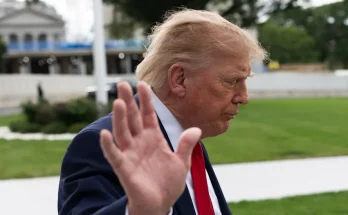
President Donald Trump addresses the nation from the Diplomatic Reception Room of the White House in Washington on December 17. (Doug MILLS / POOL / AFP via Getty Images) · DOUG MILLS via Getty Images
The revenue coming in from President Trump’s tariffs dipped in November, but the president’s oft-made promises for what he will do with the money have continued apace.
His latest pitch came on Wednesday night, when he used an address to the nation to announce new “warrior dividend” checks of $1,776 headed to 1.45 million military service members.
“The checks are already on the way,” Trump said Wednesday, adding that the approximately $2.5 billion price tag was made possible in large part because “we made a lot more money than anybody thought because of tariffs.”
It was just the latest use of tariff money, which is coming in at a much lower rate than he likes to suggest. According to Yahoo Finance’s count, the president has floated at least 10 different ideas for how tariff money could be used, stretching back to the 2024 campaign.
The promises range from sending all Americans $2,000 tariff dividend checks to paying for the tax cuts that Republicans instituted this summer.
Trump’s “warrior dividend” is at least the 10th thing he’s said tariffs could pay for. 💰 pic.twitter.com/osj4UplXmQ
— Yahoo Finance (@YahooFinance) December 18, 2025
Trump reminded the crowd at a rally in Pennsylvania this past week how he feels about tariffs, saying of the word, “I love it more than any other word in the dictionary.” He only demoted it behind other words like religion and family, he said, at the behest of the “fake news.”
Yet the tariff revenue picture has gotten considerably more cloudy in recent weeks after the president bowed to Americans’ affordability concerns and lifted some tariffs on items like coffee, oranges, and cocoa that had seen price increases.
That led to a downward tick in monthly tariff revenues in November to $30.76 billion, from $31.35 billion received in October, the first decrease since Trump began implementing his historic second-term duties.
And Trump’s promises, of course, also come as a Supreme Court decision looms that could not only invalidate the lion’s share of new tariffs, but also even potentially force him to issue refunds to the tune of up to $100 billion.
An ever-growing spending list for tariff money
It was just last week that the administration announced a $12 billion bailout fund for farmers. That money “would not be possible without tariffs,” the president said.
Scott Lincicome, an economist at the Cato Institute, quickly pointed out four additional things that Trump has promised his tariffs would pay for.
In addition to farm bailouts, dividend checks, and tax cuts, Lincicome noted Trump’s promise to pay down the national debt with tariffs and his occasional suggestion that tariffs could lead to an elimination of income taxes.
A respondent quickly pointed out a sixth example: a Trump campaign promise to pay for enhanced childcare with tariffs.
He was asked during an event last September at the Economic Club of New York about his ideas for making childcare more affordable.
“The kind of numbers that I’m talking about by taxing foreign nations at levels that they’re not used to,” he responded, “are so much bigger than any numbers that we’re talking about, including childcare.”
A review of Trump’s campaign promises and other proposals since taking office unearths even more examples, including at the same Economic Club of New York event.
“Through all this money that will be taken in through tariffs and other intelligent things … we’ll have the greatest sovereign wealth fund of them all,” he said, suggesting another use for the money.
More recently, Trump reportedly floated the idea of a “victory fund” for Ukraine, financed by new tariffs on China over its Russian oil purchases.
His administration also used tariff money to keep the Special Supplemental Nutrition Program for Women, Infants, and Children (WIC) afloat during the government shutdown with a $300 million infusion.
Ideas more expensive than what tariffs actually bring in
November’s receipts brought the total tariff revenue collected this calendar year to about $236.16 billion with one month to go.
But nearly all of Trump’s ideas have an even bigger price tag, meaning it’s unlikely he could pay for any of his bigger-ticket ideas with tariff revenue alone.
As one example, the Committee for a Responsible Federal Budget recently estimated that one round of tariff dividend checks could cost up to $600 billion and take about two years to pay off using only tariff revenues.
“Under nearly any design option, sending out $2,000 payments to Americans would increase, not decrease, the federal budget deficit,” added the Tax Foundation in its own analysis. “A better way to provide relief from the burden of tariffs would be to eliminate the tariffs.”
Earlier this year, the president also suggested that tariffs mean he could balance the budget.
But that appears unlikely anytime soon, and individual income taxes also probably aren’t going anywhere anytime soon.
The tally for those taxes this calendar year so far — as a point of comparison to the $236 billion tariff haul — is more than 10 times that, according to the Treasury Department, at over $2.5 trillion.
This story has been updated.
Ben Werschkul is a Washington correspondent for Yahoo Finance.
Read the latest financial and business news from Yahoo Finance