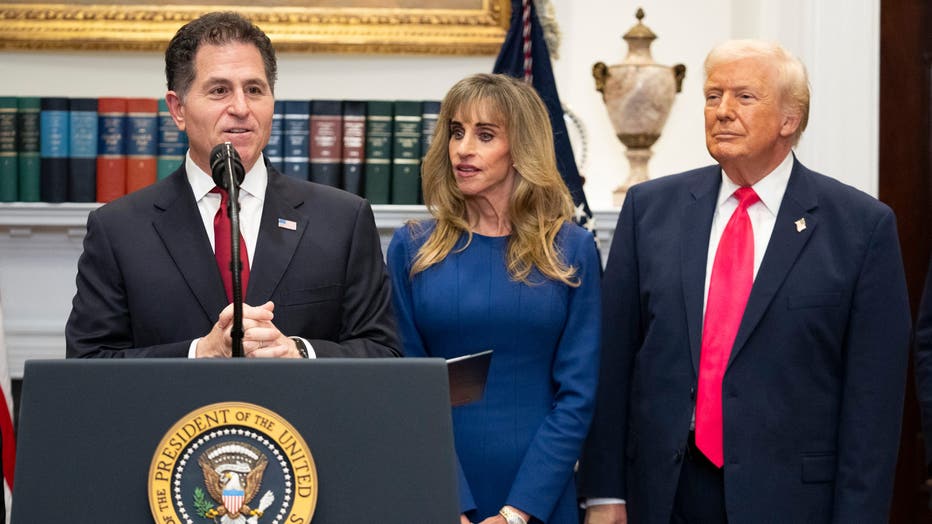
Fund investment accounts for millions of U.S. children at the White House in Washington, DC on December 2, 2025. (Credit: Carolyn Van Houten/The Washington Post via Getty Images)
Treasury Secretary Scott Bessent proclaimed that Trump accounts could turn today’s children into millionaires by the time they turn 28 at a news conference this week, where he also announced a contribution from billionaire Ray Dalio, founder of hedge fund Bridgewater Associates.
“By contributing the maximum amount each year, the Council of Economic Advisers estimates that a child’s Trump account could be worth more than $1 million by the time they turn 28,” Bessent said.
“Trump accounts will not only restore the American Dream for the next generation; they will also make it more accessible than ever before,” he said.
The Working Families Tax Cuts bill established Trump accounts, which are essentially IRAs for children. While contributions can’t be made until July 4, 2026, parents are taking notice of a new savings option — seeded with $1,000 by the government.
A Trump accounts government website provides initial details of the program, including FAQs.
Tech billionaires Michael and Susan Dell are offering to contribute an additional $6 billion to 25 million of the savings accounts, while hedge fund mogul Dalio and his wife are donating $250 per child for about 300,000 children in Connecticut, or roughly $75 million.
Dalio challenged philanthropists in every state to help fund the accounts.
You may be wondering, “What’s a Trump account, and what’s the catch?”
What are Trump accounts?
The “IRA for children” concept has been around a while, Sarah Brenner, director of education for Ed Slott and Company, told Yahoo Finance.
“It’s been proposed a number of times over the years under different names. So it’s not new,” Brenner said. One point of confusion has been that Trump accounts are strictly for educational expenses. That’s not the case.
“At age 18, the accounts become available, and you can use them for whatever you want. It’s not limited to education or anything else,” she said.
However, there is a catch.
Trump accounts vs. IRAs
There really is no “versus” here. In many ways, Trump accounts are IRAs, just with specific allowances and restrictions before age 18. A person must have earned income to contribute to an IRA, whereas Trump accounts don’t have that limitation.
Parents, grandparents — even employers — can contribute to the Trump account during the “growth period” preceding the child’s 18th birthday. However, the money is “locked down,” Brenner said. It cannot be accessed. There are no exceptions or qualified distributions.
“But then at 18, these accounts become basically traditional IRAs. When the child turns 18, they can use the money for whatever they want. But there’s going to be some taxes, and there’s going to be a 10% penalty if you’re under 59 ½ on the taxable portion of the accounts,” Brenner added.
Like a traditional IRA, the money is meant for retirement. Withdrawals will always be taxed at the account holder’s prevailing income tax bracket. If the Trump account is tapped after the child is 18 but before they’re 59 ½, they will have to pay a 10% penalty.
However, like traditional IRAs, exceptions to the 10% penalty include distributions for a first home purchase or for higher education expenses.
Trump accounts vs. 529s
There are options to Trump accounts, however, without the $1,000 free seed money from the government. Most notable are 529 accounts, specifically designed for educational expenses.
“If you use the money in the 529 for college, then you get all that growth tax-free. With the Trump account, your growth is never going to be tax-free,” Brenner said.
States work with investment firms, such as T. Rowe Price, Fidelity, and Merrill Lynch, to offer 529 plans to residents.
Trump accounts vs. education savings accounts
Coverdell Education Savings Accounts have been around since 1998. They are another educational funding vehicle, again sans the one grand.
“They work on the premise that your contributions are not deductible, but your earnings, if you use the money for education, are tax-free. And ESAs are interesting because you can use them for college, and you can use them for primary and high school expenses as well. So, K through 12,” Brenner said.
One other account to consider
Custodial accounts are another option. Guided by state laws under the Uniform Gift to Minors Act (UGMA) or the Uniform Transfers to Minors Act (UTMA), these accounts allow anyone to save and invest money on behalf of a child. The proceeds are placed under the beneficiary’s control when they are between the ages of 18 and 25, depending on the state.
The value of the account is considered when the child applies for financial aid at a college, and there are no limits to how much can be contributed, allowing for gift tax considerations.
The verdict on Trump accounts?
While 529 plans are the go-to college fund for most parents, ESAs and UTMAs have their place. Yet, the initial $1,000 (or more) deposit from the government may be enough to kick-start parents into a serious saving mode.
“If you have parents who are on board, you get the money from the government, you make $5,000 contributions to the Trump account for 18 years. You know, that’s a nice start for a kid. They turn 18, then it becomes a traditional IRA,” Brenner added. “You know, then, why not convert your traditional IRA to a Roth IRA? Then you’d have years and years of tax-free growth. So in the ideal world, if everything fell into place for someone, that would be a good outcome with a Trump account.”