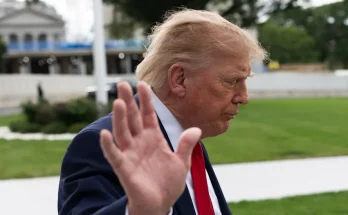
President Donald Trump speaks to reporters on the South Lawn of the White House in Washington,Susan Walsh | AP
When 2025 began, the average US tariff rate stood near 2.5%. That same rate now stands north of 15% after just less than a year of President Trump’s second term in office.
And as the calendar flips to 2026, analysts see only limited opportunities for deescalation in the year ahead.
Trump’s last major tariff move of the year came in November, when he removed tariffs on goods like coffee and cocoa, but elsewhere the president seems as intent as ever on keeping rates at current levels.
The latest calculations from the Tax Foundation find that the average applied US tariff rate is 15.8%; the Yale Budget Lab calculates an overall average effective tariff rate for consumers of 16.8%.
Both outlets note these levels mark the highest rates in at least 80 years.
Meanwhile, a Yahoo Finance review of tariff projections for 2026 saw 15% crop up again and again as a general rule of thumb when planning for tariffs in the coming year.
In other words: not a major change.
As Bloomberg Economics put it in a recent note, the global economy will now have to learn to live with American protectionism.
‘You can see the end point’
In an interview that aired during the last weekend of the year on CBS News’ Face the Nation, Bank of America CEO Brian Moynihan said his team had concluded that on tariffs, things are “starting to deescalate” and that overall rates for companies that “drive more towards America … will come down to 15%.”
He quickly added that there could be major exceptions, but for many around the globe, “You can sort of see the end point here.”
That 15% number was echoed in other analyses and is seen as likely to hold even with the Supreme Court currently weighing the legality of many of Trump’s tariffs.
A negative ruling for Trump from the high court could be far-reaching and even require tariff refunds, but few expect it to permanently knock the White House away from its tariff focus.
As JPMorgan noted in an analysis in early December, even an adverse ruling in the Supreme Court could result in rates holding near current levels, with the administration possibly opting to “invoke Section 122 to maintain 15% tariffs for 150 days, using that period of time to work out more lasting alternatives.”
Economists at Bloomberg Economics added that the Supreme Court is likely to strike down some of Trump’s tariff authority, but “our base case is that these tariffs will be swiftly replaced,” they wrote in a research note, adding that it is likely that tariff rates “will largely hold where they are now.”
Other factors are fueling some predictions for moderate downward pressure on tariff rates in 2026, mostly around a coming election year in the US, which is expected to see Trump and Republicans under continued pressure around Americans’ affordability concerns.
Yet Trump himself is signaling little appetite for major changes in his plans, posting to Truth Social Saturday that “Tariffs are creating GREAT WEALTH, and unprecedented National Security for the USA.”
And as Trade Representative Jamieson Greer put it in an op-ed this past week, “2025 will be remembered as the year of the tariff.” From his view, “the plan is working.”
As of November, the total revenue collected for 2025 from tariffs is $236.16 billion, with revenue dipping slightly in November after the White House released its executive order that excluded items such as coffee, tea, beef, bananas, tropical fruit, and cocoa from tariffs.
2026 as the ‘year of the tariff consequences’
What likely won’t be available to businesses in 2026, however, will be opportunities get ahead of tariffs, either by stockpiling imports or shifting the location of some production to avoid a one-time price shock for customers.
In a recent report, Deloitte US suggested tariff rates will move “to 15% by the first quarter of 2026,” but also added that “importers who built up their inventories ahead of tariffs will ultimately need to replenish those goods at tariffed rates, as domestic production has not fundamentally changed.”
As longtime shipping observer John McCown, a non-resident senior fellow at the Center for Maritime Strategy, added in a LinkedIn post, “I believe 2026 will be the year of the tariff consequences.”
Indeed, even with moderate deescalation possible on some goods in 2026, no notable year-end analysis foresees any sort of massive shift in Trump’s tariff program.
As Terry Haines, the founder of Pangaea Policy, noted, “tariffs are here to stay.”
Haines added that for investors, this might end up being a good thing because of the clarity for markets that this tactic will be the “main tool of Trump geopolitics [and] economic policy” in the coming three years.
“It increases economic policy certainty,” Haines wrote, with consequences that can be managed later.
Ben Werschkul is a Washington correspondent for Yahoo Finance.
Click here for the latest economic news and indicators to help inform your investing decisions
Read the latest financial and business news from Yahoo Finance