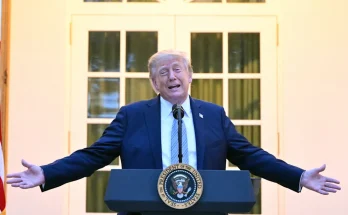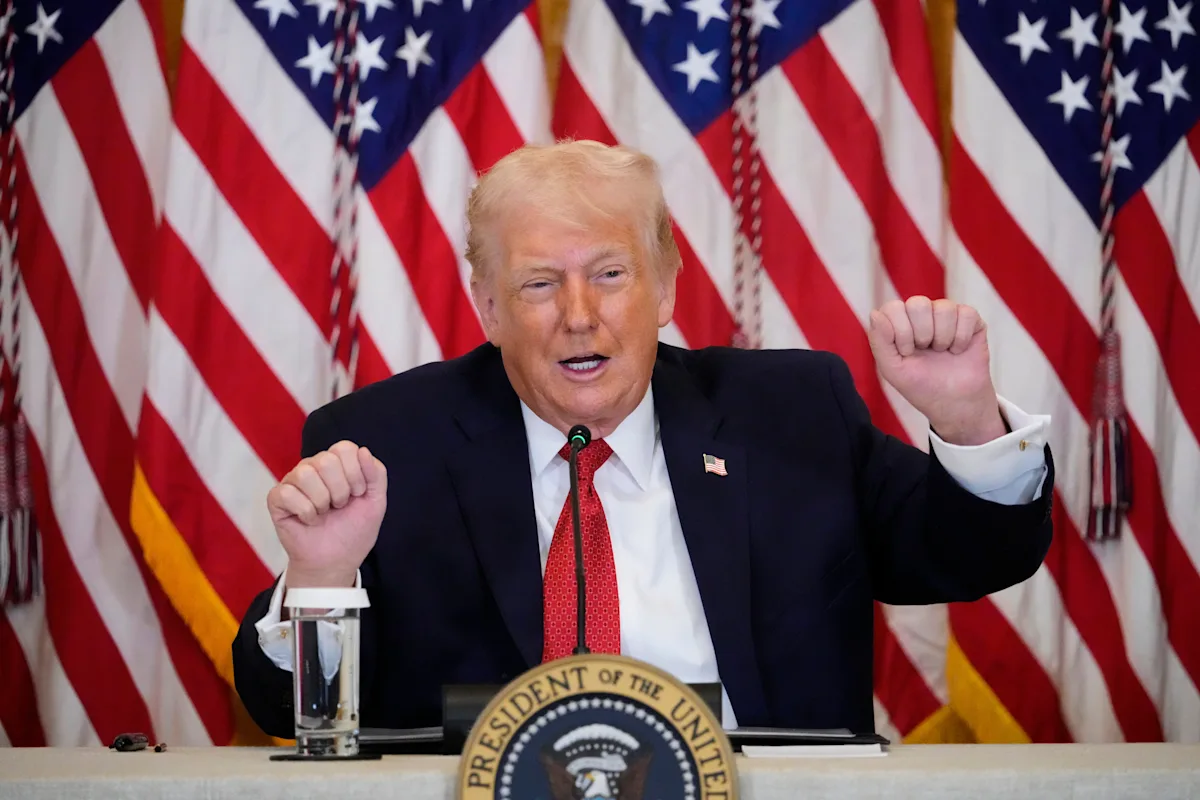
President Donald Trump speaks during an event to promote investment in rural health care in the East Room of the White House, Friday, Jan. 16, 2026, in Washington. (AP Photo/Alex Brandon)
COPENHAGEN, Denmark — President Donald Trump said Friday he could impose trade penalties on countries that refuse to support U.S. control of Greenland, escalating a long-running dispute even as a bipartisan group of American lawmakers traveled to Denmark in an effort to ease growing diplomatic strain.
For months, Trump has argued that the United States must take control of Greenland, a semiautonomous territory belonging to NATO ally Denmark. Earlier this week, he said anything short of the Arctic island falling under U.S. authority would be “unacceptable.”
Speaking at a White House event focused on rural health care, Trump recalled how he previously threatened European nations with tariffs on pharmaceutical imports.
“I may do that for Greenland too,” he said. “I may put a tariff on countries if they don’t go along with Greenland, because we need Greenland for national security.”
It was the first time Trump publicly suggested using tariffs as leverage in the Greenland dispute.
Earlier in the week, Danish and Greenlandic foreign ministers met in Washington with Vice President JD Vance and Secretary of State Marco Rubio. While no breakthrough was reached, the talks produced an agreement to form a working group — though Denmark and the White House later offered sharply different explanations of its purpose.
European leaders have maintained that only Denmark and Greenland can decide the island’s future. Denmark announced this week that it is strengthening its military presence in Greenland in coordination with allies.
A relationship that ‘we need to nurture’
As Trump sharpened his rhetoric, a delegation of U.S. senators and representatives met Friday in Copenhagen with Danish and Greenlandic lawmakers, including Danish Prime Minister Mette Frederiksen.
Sen. Chris Coons of Delaware, who led the delegation, thanked Danish leaders for more than two centuries of partnership and said the talks focused on strengthening cooperation going forward.
“We had a strong and robust dialogue about how we extend that into the future,” Coons said.
Sen. Lisa Murkowski, an Alaska Republican, said the visit underscored a relationship built over decades.
“It is one that we need to nurture,” she said, adding that Greenland should be treated as a partner rather than a possession.
“Greenland needs to be viewed as our ally, not as an asset,” Murkowski said.
Their tone contrasted sharply with the White House’s stance. Trump has repeatedly argued that China and Russia are seeking greater influence over Greenland, which holds vast reserves of critical minerals. The administration has not ruled out the possibility of using force to gain control of the territory.
Aaja Chemnitz, a Greenlandic lawmaker who participated in Friday’s meetings, said the most immediate pressure Greenland faces is coming from Washington.
“We have heard so many lies and so much exaggeration about the threats toward Greenland,” she said. “Mostly, the threats we’re seeing right now are from the U.S. side.”
Murkowski also stressed that public opinion in the United States does not support a takeover.
“When you ask the American people whether this is a good idea, about 75% say it is not,” she said.
Murkowski and Sen. Jeanne Shaheen of New Hampshire have introduced bipartisan legislation that would bar the use of Defense or State Department funds to annex Greenland — or any NATO member’s territory — without that ally’s consent or approval from the North Atlantic Council.
Inuit leaders warn against new colonialism
The controversy has deeply affected daily life in Greenland. Prime Minister Jens-Frederik Nielsen said this week that if forced to choose, Greenland would stand with Denmark, NATO, and the European Union.
The Inuit Circumpolar Council, which represents roughly 180,000 Inuit across Alaska, Canada, Greenland, and Russia’s Chukotka region, criticized repeated White House statements that the U.S. must own Greenland.
Sara Olsvig, the council’s chair, said such language reveals how powerful nations view smaller and Indigenous populations.
“It shows how one of the world’s biggest powers views peoples who are less powerful,” she said. “That is deeply concerning.”
She added that Greenland’s Indigenous population does not want to experience colonization again.
Superville reported from Washington. Emma Burrows in Nuuk, Greenland, and Geir Moulson in Berlin contributed to this report.