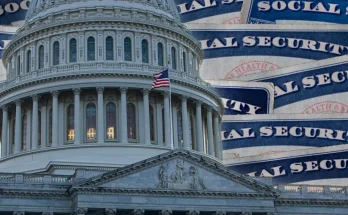
Millions of Americans are increasingly anxious about the future of Social Security, as new projections show the program’s main retirement trust fund could face a funding shortfall within the next decade. While experts stress that Social Security is not going bankrupt, concerns remain about potential benefit reductions if lawmakers fail to act.
“There is no bankruptcy or collapse in the cards,” said Stephen Nuñez, director of stratification economics at the Roosevelt Institute. Still, uncertainty about long-term funding has left many retirees and workers uneasy.
Social Security provides monthly income to retirees, people with disabilities, and surviving spouses and children of deceased workers. Any disruption to those payments would affect tens of millions of households nationwide.
Why Social Security Is Facing Another Funding Scare
The concern centers on the Old-Age and Survivors Insurance (OASI) Trust Fund, which pays retirement and survivor benefits. According to current projections, the fund is expected to be depleted by 2033.
If that happens and Congress takes no action, Social Security would still collect payroll taxes — but only enough to cover about 77% of scheduled benefits, meaning across-the-board reductions for retirees and survivors.
The situation is different for disability benefits. The Disability Insurance (DI) Trust Fund is projected to be able to pay 100% of scheduled benefits through at least 2099, according to federal estimates.
Some policymakers have floated the idea of combining the two trust funds as a temporary fix. But analysts warn that doing so would only delay the problem slightly. If merged, the combined funds would run dry by 2034, at which point about 81% of benefits could be paid.
Public Anxiety Is Growing
A 2025 survey by Nationwide Financial found that 74% of Americans worry Social Security will run out during their lifetime — a reflection of how deeply the program’s future weighs on workers and retirees alike.
Nuñez argues that the fear itself is misplaced.
In a report titled “‘Will Social Security Run Out?’ Is the Wrong Question,” he notes that the program has faced similar crises before — and survived.
“We have been here before,” Nuñez wrote. “And, quite obviously, the Old-Age and Survivors Insurance program did not collapse.”
He pointed to the early 1980s, when Social Security faced an imminent funding shortfall. In response, lawmakers approved temporary bridge funding and created the National Commission on Social Security Reform.
That bipartisan commission ultimately led to sweeping changes, including:
- Payroll tax increases
- A gradual increase in the full retirement age
- Other long-term adjustments designed to stabilize the program
What Could Happen to Benefits If Congress Does Nothing
Even without legislative action, experts emphasize that Social Security checks would not stop altogether.
“Even if nothing is done, people will continue to receive the bulk of their benefits,” said Alicia Munnell, senior advisor at the Center for Retirement Research at Boston College.
However, several scenarios are possible if lawmakers fail to act, according to economists and policy analysts:
- Across-the-board benefit cuts
- Prioritizing payments for the most vulnerable beneficiaries
- Delays in benefit payments during periods of cash strain
The size of any potential cut would vary widely depending on a person’s work history, earnings, age, and marital status, according to the Committee for a Responsible Federal Budget (CRFB).
CRFB estimates suggest:
- High-income couples could face annual benefit reductions of about $24,400
- Typical single-earner couples could see cuts of around $13,800 per year
- Dual-income couples might lose roughly $11,200 annually
What Americans Can Do to Prepare
While the future of Social Security ultimately depends on Congress, individuals can take steps now to protect their retirement security.
For Workers
- Increase 401(k) or IRA contributions to reduce reliance on Social Security income
- Delay retirement if possible, which increases monthly benefit amounts
- Understand that claiming benefits early — as early as age 62 — permanently reduces monthly payments
Workers born in 1960 or later reach full retirement age at 67, when they are eligible for 100% of their earned benefit.
For Current Retirees
- Review household budgets and consider reducing discretionary spending
- Rely more heavily on personal savings or pensions, if available
- Monitor policy developments that could affect future benefit levels
The Bottom Line
Social Security is not on the verge of collapse, but it is approaching a familiar crossroads. Without congressional action, retirees may eventually face reduced benefits — not eliminated ones.
As lawmakers debate how to shore up the program once again, Americans are left balancing reassurance from experts with the reality that the system’s long-term future still depends on political decisions yet to be made.
This article is for informational purposes and reflects projections and expert commentary available as of early 2026.