For years, Americans have heard the warnings.
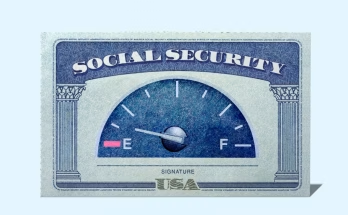
Social Security has a money problem.
The system that millions of older Americans depend on is facing a future funding shortfall — and that future is no longer far away.
Now, new updates suggest a major Social Security change may be closer than many people realize.
For retirees, widows, divorced spouses, and people approaching retirement, this matters in a very personal way.
It could affect:
- Monthly benefit amounts
- Cost-of-living increases
- Medicare deductions
- Retirement age
- Survivor and spousal rules
- Long-term financial security
This is not about panic.
It is about being informed.
Why People Are Talking About a Big Change
Social Security is funded mainly by payroll taxes.
Workers pay in. Retirees, survivors, and disabled Americans receive benefits.
But the system is under pressure for several reasons:
| Pressure | What It Means |
|---|---|
| Americans living longer | Benefits paid for more years |
| Baby Boomers retiring | More people drawing benefits |
| Lower birth rates | Fewer workers paying in |
| Rising healthcare costs | More financial pressure on retirees |
| Inflation | Higher cost of living |
| Trust fund shortfall | Long-term solvency concerns |
These pressures have been building for years.
Now they are reaching a point where lawmakers may have to act.
The Most Important Question: Is Social Security Ending?
The short answer:
No. Social Security is not ending.
Even in the worst-case projections, Social Security would still pay benefits.
The risk is not that checks stop completely.
The risk is that future checks could be smaller than promised if Congress does not act.
| Question | Simple Answer |
|---|---|
| Will Social Security disappear? | No |
| Will checks stop entirely? | No |
| Could benefits be reduced? | Yes, if Congress does nothing |
| Can Congress fix it? | Yes |
| Should retirees panic? | No, but stay informed |
This is the most important truth for older Americans to understand.
What the Trust Fund Shortfall Really Means
Social Security has trust funds that help pay benefits when payroll taxes are not enough.
These trust funds are projected to run short in the mid-2030s if no changes are made.
If that happens, payroll taxes would still come in. But they may only cover about 80% of scheduled benefits.
That means a person expecting $2,000 a month could receive about $1,600 instead.
For retirees on a fixed income, that gap could be serious.
| Expected Monthly Benefit | Possible Amount at 80% | Possible Monthly Loss |
|---|---|---|
| $1,500 | $1,200 | $300 |
| $2,000 | $1,600 | $400 |
| $2,500 | $2,000 | $500 |
| $3,000 | $2,400 | $600 |
These are only examples.
Congress could prevent this by acting before the shortfall happens.
Why a Change May Be Closer Than People Think
In the past, the trust fund shortfall felt distant.
Now, the date is moving closer.
That means lawmakers may face growing pressure to act sooner.
A major Social Security change could come in the form of:
- A new retirement age rule
- A new payroll tax change
- A new benefit formula
- A new cost-of-living adjustment rule
- New protections for low-income retirees
- New rules for higher earners
Some of these changes may be small.
Some may be larger.
But they could affect almost every American who depends on Social Security.
Possible Changes Lawmakers Are Considering
No final decisions have been made.
But several ideas have been discussed in Washington for years.
| Possible Change | What It Could Mean |
|---|---|
| Raise payroll taxes | Workers may pay more |
| Raise the wage cap | Higher earners may pay more |
| Raise full retirement age | Future retirees may wait longer |
| Change benefit formula | Some checks may grow more slowly |
| Change COLA rules | Yearly increases may be different |
| Protect lower-income retirees | Smaller checks may get extra protection |
| Adjust survivor benefits | Widows could see different rules |
Congress may choose one option, or a mix of several.
Who Could Be Affected the Most
A future Social Security change would not affect everyone the same way.
Current Retirees
Many proposals try to protect current retirees from major benefit cuts.
But they may still see changes to:
- Cost-of-living increases
- Medicare deductions
- Taxes on benefits
- Overpayment rules
For widows and divorced retirees living on a fixed income, even small changes can have a big impact.
People Close to Retirement
People in their 50s and 60s may need to pay the most attention.
They are close to retirement but still young enough to be affected by new rules.
Possible impacts include:
- A higher full retirement age
- A new benefit formula
- Smaller annual increases
- New tax rules
Younger Workers
Younger workers may see the biggest long-term changes.
They may have to:
- Work longer
- Pay more in payroll taxes
- Save more outside Social Security
- Plan for Social Security to cover less of their retirement income
Why This Matters for Older Women Especially
For many older American women, Social Security is more than a monthly check.
It is independence.
It is safety.
It is the money that helps them stay in their home and care for themselves.
Women statistically live longer than men. That means:
- Many older women live alone for years
- Many depend on survivor or divorced spouse benefits
- Many rely on Social Security as their primary income
- Many are highly affected by Medicare costs and inflation
For these women, even a small change can shift the entire monthly budget.
| Monthly Concern | Why It Matters |
|---|---|
| Rent or housing | Often the biggest bill |
| Medicare costs | Reduce the bank deposit |
| Groceries | Food prices remain high |
| Medicine | Prescriptions can be costly |
| Utilities | Heat, water, electricity |
| Transportation | Rides to doctors and family |
Any change to Social Security ripples through every part of daily life.
How a Change Could Affect Cost-of-Living Increases
Each year, Social Security usually adjusts benefits for inflation.
This is called the Cost-of-Living Adjustment (COLA).
If Congress changes the COLA formula:
- Annual raises could be smaller
- Benefits may not keep up with inflation
- Seniors could lose buying power over time
Even a small change in the COLA rule can add up over many years.
For a widow or a long-retired senior, that can be the difference between covering bills and falling behind.
How a Change Could Affect Medicare Costs
Medicare premiums often come directly out of Social Security checks.
If Medicare costs rise faster than Social Security increases:
- The deposit shrinks
- Seniors take home less
- Fixed-income retirees feel the most pressure
This is one of the biggest reasons older Americans pay close attention to Social Security changes.
It is not just about the benefit amount.
It is about what actually lands in the bank account.
How a Change Could Affect Survivor and Spousal Benefits
For widows and divorced retirees, survivor and spousal benefits are especially important.
A future change could affect:
- Survivor benefit amounts
- Divorced spouse rules (10-year marriage requirement)
- Remarriage rules
- Claiming age for survivor benefits
- Coordination with the surviving spouse’s own benefit
Many older women rely on these rules to receive the highest possible monthly benefit.
If any of these rules change, the impact on widows and long-term divorced retirees could be significant.
What Retirees Should Do Now
Nobody knows exactly what Congress will do or when.
But there are smart steps every retiree and worker can take.
| Step | Why It Helps |
|---|---|
| Check your Social Security statement | Make sure your earnings record is correct |
| Know your full retirement age | Affects your monthly benefit |
| Review your claiming plan | Claiming early permanently reduces checks |
| Understand survivor and spousal options | Widows may qualify for more |
| Plan for Medicare costs | Premiums reduce deposits |
| Keep an emergency cushion | Helps if expenses rise |
| Avoid relying only on Social Security | Adds extra protection |
| Watch for scams | Protect personal information |
These steps cannot fix the entire system.
But they can help individual families feel more prepared.
Warning: Watch Out for Scams During Times of Change
Whenever Social Security is in the news, scammers become more active.
They may pretend to be from the Social Security Administration and use fear to trick older Americans.
Warning signs include:
- Calls saying your number is suspended
- Threats of arrest if you do not pay
- Demands for gift cards, wire transfers, or cryptocurrency
- Requests for your full Social Security number
- Messages saying benefits will stop unless you act now
Social Security will never threaten you or demand instant payment.
If something feels wrong, hang up and contact Social Security directly.
What Older Women Should Pay Closest Attention To
For widows, divorced retirees, and women living alone, here are the most important areas to watch:
| Area | Why It Matters |
|---|---|
| Survivor benefits | Widows may qualify for more |
| Divorced spouse rules | Long-term divorced women may qualify |
| Medicare deductions | Affect the real deposit |
| COLA changes | Affect long-term buying power |
| Retirement age changes | Affect future planning |
| Overpayment rules | Protect against surprise reductions |
| Scams | Protect personal information |
A small change in any of these areas can affect daily life.
The Most Important Message
A major Social Security change may be closer than many people think.
But that does not mean retirees should panic.
It means they should:
- Stay informed
- Understand their benefits
- Review their options
- Protect their money
- Plan for the future
Social Security is not ending. Monthly checks are still being paid. And many proposed changes include protections for current retirees and low-income seniors.
The best response is calm, careful preparation — not fear.
The Bottom Line
A major Social Security change may be coming sooner than expected.
It could affect:
- Future benefit amounts
- Cost-of-living increases
- Medicare costs
- Retirement age
- Survivor and spousal rules
- Long-term financial security
For older Americans — especially women living on a fixed income — these changes could shape daily life.
But the core message remains simple:
Social Security is not ending. Stay informed. Stay prepared. Stay independent.
For millions of retirees, widows, and divorced seniors, Social Security still represents what it always has — a foundation of stability, dignity, and peace of mind.