For the nearly 55 million retired workers who brought home a Social Security benefit in July, there are few events more anticipated than the annual cost-of-living adjustment (COLA) reveal, which is slated for Oct. 14.
Social Security’s COLA is a near-annual raise given to beneficiaries to offset the effects of inflation. For instance, if a broad basket of goods and services regularly purchased by seniors rises in cost by 4% from the previous year, Social Security benefits would need to climb by the same percentage to avoid a loss of purchasing power.
Missed Nvidia in 2009? This Rare Signal Is Flashing Again. In 2009, a “Double Down” signal flashed for a little-known chipmaker called Nvidia. For the first time in years, that same “Total Conviction” signal is flashing for a company 1/100th the size of Nvidia. Continue »
Since the Consumer Price Index for Urban Wage Earners and Clerical Workers became the program’s inflation-measuring yardstick in 1975, Social Security recipients have received a COLA in all but three years (2010, 2011, and 2016).
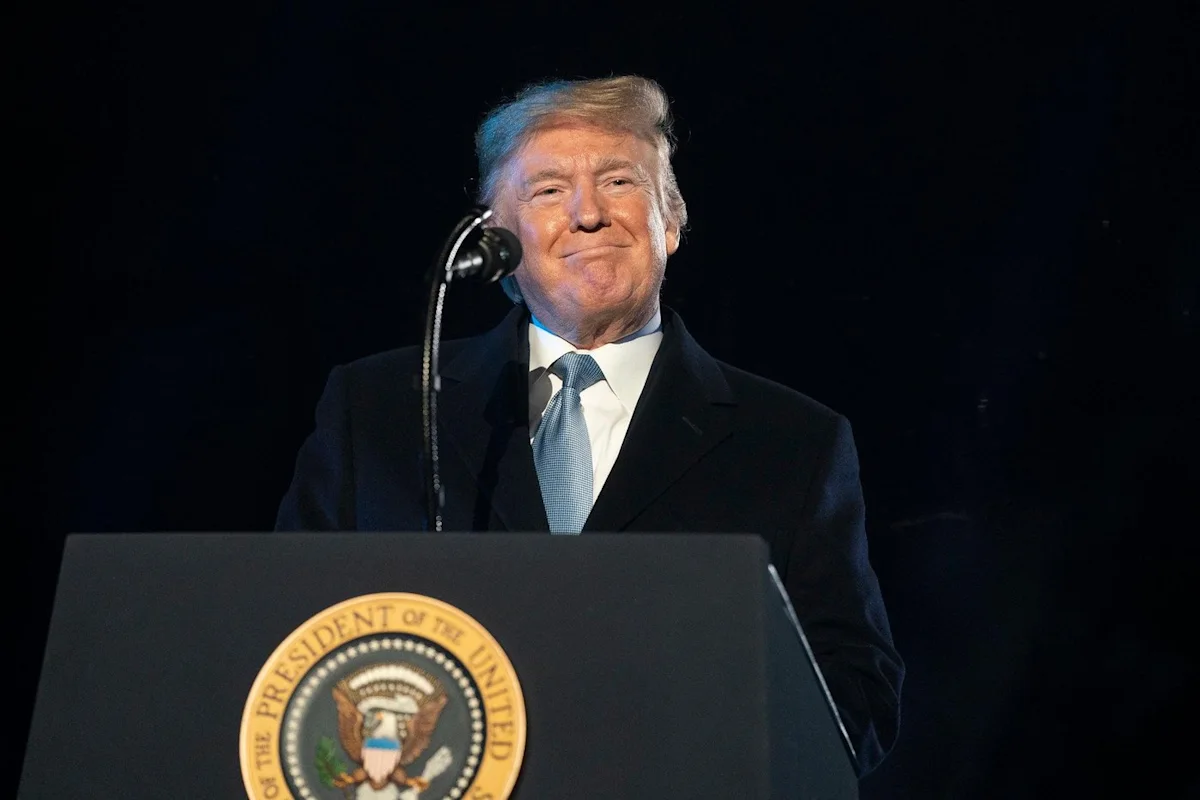
President Trump’s policies are having a direct impact on Social Security’s annual raise. Image source: Official White House Photo by Joyce N. Boghosian, courtesy of the National Archives.
The program’s 2027 COLA is shaping up to be particularly historic, courtesy of President Donald Trump. For a second consecutive year, Social Security benefits will be privy to a “Trump bump.” But in 2027, it should lead to something that hasn’t been witnessed in 30 years!
Social Security’s Trump bump-led 2027 raise is set to make history
A Trump bump (i.e., a beefier cost-of-living adjustment directly driven by President Trump’s policies) is nothing new for Social Security. The 2.8% raise beneficiaries received this year was modestly boosted by the president’s tariff and trade policy.
On April 2, 2025, Trump unveiled his long-touted tariff policy, featuring sweeping global tariffs and higher reciprocal tariffs on dozens of countries deemed to have unfavorable trade imbalances with America. Despite the U.S. Supreme Court striking down the bulk of these tariffs in February 2026, their imposition last year increased consumer prices and lifted Social Security’s 2026 COLA.
For 2027, two of the president’s policies are set to increase benefits.
The first is, once again, tariffs. In July 2026, the Trump administration reimposed sweeping global tariffs on more than 80 countries using a different justification. Adding duties to unfinished imported goods, such as steel, risks increasing domestic manufacturing costs. If U.S. production costs rise, they’re often passed on to consumers, resulting in modestly higher inflation and, ultimately, a beefier cost-of-living adjustment.
BREAKING: US July PCE inflation, the Fed’s preferred inflation metric, hits 3.7%, above expectations of 3.6%.
Core PCE inflation was 3.3%, the second highest reading since October 2024.
US inflation continues to run at nearly double the Fed’s 2.0% target.
Own assets or be left behind.
— The Kobeissi Letter (@KobeissiLetter) August 26, 2026
The second policy set to boost benefits in 2027 is the Iran war. Shortly after Trump green-lit military attacks against Iran on Feb. 28, the latter shut down the Strait of Hormuz to virtually all maritime traffic. This move effectively halted the flow of a fifth of the world’s daily petroleum liquids. The subsequent spike in fuel prices, caused by the largest modern-day energy supply disruption, sent the prevailing inflation rate to a three-year high of 4.2% in May.
There’s also strong evidence that Iran-war-driven inflation has seeped beyond the energy sector into the broader economy. The price stickiness of Core Personal Consumption Expenditures, an inflationary measure that excludes volatile food and energy costs, indicates that higher costs associated with the Iran war are impacting consumer prices.
Following the July inflation report, The Senior Citizens League, a nonpartisan senior advocacy group, estimated that Social Security’s 2027 COLA would come in at 3.6%. Meanwhile, independent Social Security and Medicare policy analyst Mary Johnson adjusted her COLA projection to 3.4%.
The average of these two estimates calls for a 3.5% increase in monthly benefits in 2027. If these independent estimates are remotely close to the reported raise on Oct. 14, it’ll mark the sixth consecutive year in which benefits have increased by at least 2.5%: 5.9% (2022), 8.7% (2023), 3.2% (2024), 2.5% (2025), 2.8% (2026), and 3.5% est. (2027).
Social Security beneficiaries would have to go back 30 years to find the last time payouts rose by at least 2.5% for six straight years. From 1988 through 1997, benefits increased by at least 2.6% annually.
Thanks to back-to-back Trump bumps, we’re almost certain to witness Social Security history next year.
Trump bumps have a dark side, too
Unfortunately, larger monthly Social Security checks can come with serious consequences for America’s leading retirement program.
When 2026 began, there was no question that Social Security’s financial foundation was weakening. For four decades, the annually published Social Security Board of Trustees Report had cautioned of a long-term (75-year) unfunded obligation. Put simply, the Trustees forecast considerably more Social Security outlays (primarily benefits, but also administrative expenses to oversee the program) than income collected.
In the 2026 Trustees Report, this 75-year funding shortfall estimate ballooned to $29.3 trillion, driven primarily by several ongoing demographic shifts, such as lower U.S. birth rates, lower net legal migration into the U.S., rising income inequality, and the retirement of baby boomers.
But the more glaring issue is the projected depletion of the Old-Age and Survivors Insurance trust fund’s (OASI) asset reserves by the fourth quarter of 2032. Although the OASI (and Social Security as a whole) are in no danger of bankruptcy or halting payouts, the exhaustion of this excess capital would necessitate sweeping benefit cuts for retired workers and survivors of deceased workers of up to 22%.
When the Trustees model their financial outlooks, they assume relatively modest annual raises. Based on independent estimates, next year’s Trump bump is shaping up as anything but modest. While a midpoint-estimated 3.5% COLA would pack a nominal punch for most beneficiaries, it threatens to drain the OASI’s asset reserves even faster than initially forecast.
In other words, the higher the inflation rate (and Social Security’s COLA), the sooner we could be talking about sweeping Social Security benefit cuts, which are currently about six years away.
The $23,760 Social Security bonus most retirees completely overlook
If you’re like most Americans, you’re a few years (or more) behind on your retirement savings. But a handful of little-known “Social Security secrets” could help ensure a boost in your retirement income. For example: one easy trick could pay you as much as $23,760 more… each year! Once you learn how to maximize your Social Security benefits, we think you could retire confidently with the peace of mind we’re all after.
Many Americans leave money on the table in retirement. Learn more about these retirement strategies and more, available when you join Stock Advisor.
View the “Social Security secrets” »
The Motley Fool has a disclosure policy.
Social Security’s Trump Bump-Driven 2027 COLA Is Set to Do Something That Hasn’t Been Witnessed in 30 Years was originally published by The Motley Fool